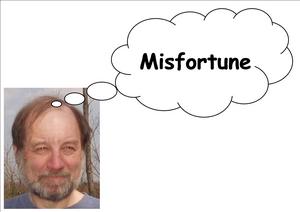
Is it possible to suffer a misfortune or a harm of which we are completely unaware? At first sight the idea seem ridiculous. It's like someone telling you they have just discovered that yesterday they had been suffering a toothache all day but were quite unaware of it at the time!
Consider the following situation, however...
John is universally judged to be a competent manager. A new project is mooted by higher management and "water-cooler" conversations lead to the informal proposal that John should be earmarked to lead the project. It will mean a higher salary for him, more responsibility, higher status and greater job satisfaction. Everyone agrees that he is the right man for the job and that he would enjoy the challenge. However, Alan has it in for John and fabricates evidence that John has had mental problems in the past. The management simply accept what Alan says on face value and quietly drop the idea of promoting John to project leader. Years later, after all the characters in our drama have passed away, John's biographer comes across evidence of Alan's deceit. He judges that what Alan did indeed harm John and writes in his biography that John's career was blighted by the malice of Alan.
The biographer's judgement seems to me to be quite correct. Had Alan not acted in the way that he did John would have experienced a benefit that, in the event, he was denied. Alan has clearly done John a harm. But the problem is that this contradicts our previous intuition for John has not experienced anything disagreeable.
Many people balk at the idea that a third-party's judgement (such as the biographer's) can override or somehow negate the subjective judgement of the person themselves. After all, what right have I got to gainsay your claim that you are happy? Surely you are the ultimate authority on your own happiness? However, if we insist that a misfortune is only a misfortune if you experience it then we have to conclude that Alan has done John no harm. Furthermore, any betrayal, gossip, infidelity or theft that remains undiscovered is never wrong in itself. It only becomes wrong when it is discovered and the resultant distress is experienced; what renders something wrong is only consequent bad experiences.
This would put a colleague who learnt about Alan's deceit in a paradoxical position. If he informs John about the loss of the job opportunity, John will feel anger and disappointment and so the colleague automatically will come to share responsibility with Alan for causing a harm to John! Without his action John will not have suffered anger and disappointment. This clearly goes against our common-sense beliefs about harms for we usually praise people who bring injustices to light - not blame them for causing distress - even though their actions may lead to the experience of distress. If John discovers the wrong done to him by Alan through his colleague's information then the distress he experiences will be as a result of what Alan did - not as a result of his colleague bringing it to light. The colleague cannot share the blame of the harm just for making John aware of it. In addition, the law does not treat the wrongness of a crime as consisting in the distressing awareness of it. If a fraud was committed two months ago it was wrong then - not just when I discover and report it.
I think the problem of our contradictory intuitions lies in what appears to be a conflict between two opposing viewpoints. On the one hand we have the first-person viewpoint of John ("I am happy and contented") and the third-person viewpoint of the biographer ("John has suffered and so is unhappy"). It seems illegitimate for someone to make such a judgement in the face of an authoritative judgement made by a person about their own state of mind.
The answer is that the third-person perspective is bit more subtle than I have described it. The biographer is not really saying "I judge John to have suffered a misfortune". Rather, he is putting himself in John's place, empathetically, and saying "If John had known about Alan's action then I judge he would have been distressed because he would recognise that an objective harm had been done to him. Therefore, he has suffered a misfortune even though he did not discover the deceit and experienced the distress".
The implication of this is that our individual lives cannot be seen and evaluated simply in terms of our here and now subjectivity - the flow of conscious experiences - but have to be viewed as stories in an objective world in which the third-person perspective is as important as the first.



32 comments:
Fascinating! I loved the way this teased out the implications of John and Alan's situation.
This is a very clear explanation of an apparent paradox, and does suggest that there is some validity to the idea of an 'objective' viewpoint - something I've always intuitively believed but never quite been able to justify logically.
This is the sort of discussion that most people rightly walk away from. It's like a magic trick. once the linguistic sleight of hands are uncovered the apparent paradoxes disappear. The writer comes close to admitting this half way through the bubble.
The first linguistic trick is the title - misfortune. John does not suffer misfortune. He is the victim of a hate campaign. We don't know its nature but it could be criminal. Is it possible to be the victim of a criminal act of which we are completely unaware? Yes of course we can.
Second there are two consideratons being assessed by the biographer. The first is John's reaction in discovering that he had been the victim of a hate campaign. Secondly there is John's reaction to the consequence of Alan's hate campaign.
No doubt John would have been most dstressed to learn of Alan's action. As to his reaction to the consequences of his action we cannot be so certain. John lived a happy life. Staying in his present position brought him joys and pleasures. Had he been given the opportunities of the promotion then he would have had other joys and pleasures (and no doubt other frustrations and pains) Had he taken the promotion he might have had to forgo the pleasures and joys of the life he did lead. Would the pleasures of he promotion have made up for the loss of the pleasures of the job his continued doing? They may well have done.
The third sleight of hand is the use of the word suffer. John was the victim of a hate campaign. But whether this led to any suffering to John during his life may not be the case. John was not given promotion. Again whether John suffered because of this may or may not be the case. Had he known of the campaign against him he might well have suffered distress. Had he known he was deprived of the job he might have suffered distress. John's career did not advance as it might have done. However if John did not suffer during his life, he did not suffer during his life. Careers are not people and do not suffer. Imagined sufferings are not sufferings.
Certainly we should evaluate our lives from as wider perspective as possible. And that evaluation will change as new evidence comes to light and opions change as to the rights and wrons of certain actions. A wider perspective is not the same as an objective perspective.
The only real question is why the author considers a hate campaign a misfortune.
When I first wrote this piece I wanted to challenge the old adage "What the eye doesn't see, the heart doesn't grieve', frequently the excuse used by men who are unfaithful to their wives. 'If she doesn't know I'm having an affaire then she wont feel hurt and I therefore I haven't done her any harm'. But surely, the unfaithful husband is still doing a harm to his wife by his deceit and betrayal of trust whether of not she is aware of it?
What I want to ask is whether something 'bad' can happen to you that you are unaware of; and by 'bad' I also mean 'being deprived of goods you would otherwise have enjoyed'. Suffering is normally taken to be simply a subjective state. I want to say that deprivation of a good - even if you are unaware is also a form of 'suffering'.
Smitch seems to agree that in principle you can suffer something bad that you are unaware of. In his second paragraph he admits "Is it possible to be the victim of a criminal act of which we are completely unaware? Yes of course we can."
What Smitch seems to be focusing on is an interesting tangential point regarding accidental or deliberate harms. He rightly points out is that I am using the word 'misfortune' in a very broad and loose sense meaning anything bad happening to you regardless of the intentionality behind it. I don't think my use of the word is illegitimate. It is frequently used like this in everyday speech just to mean 'something bad that's happened to me'. However, I don't think anything hangs on linguistic usage here.
Consider the following modification of our scenario:
The manager, who is new to the company does not know John and so he asks for John's file in order to evaluate his suitability for the new post. Unfortunately(!) the secretary pulls the wrong file by accident and gives the manger the file of another employee with the same name. This employee has a dreadful record of disciplinaries and so the manager decides not to promote John. This is completely accidental and so I would call it a misfortune in the narrower sense of the word preferred by Smitch. The point is that John has been deprived of a good (not subject to an positive, subjectively experienced suffering as such) that he would have enjoyed had the mistake not been made. The depivation is the same whether it is as a result of deliberate malice or accident.
My question to Smitch is whether he believes that being deprived of a good that you would otherwise have enjoyed is a 'bad thing' in itself (I refrain from the use of 'misfortune' out of respect for his sensibilities!). The example that comes to mind is the couple in the news a few years ago who lost their winning lottery ticket. They still had the machine receipt so they knew they had had the right numbers but because they could not produce the actual ticket their claim was rejected by the lottery company. The plain fact is that they were, in one sense, no worse off than they had been every other week when they checked their tickets and found them contain losing numbers. No one had taken anything away from them in the sense that a burglar takes your goods away - and yet they still felt a profound loss. It was the loss of a *possibility* that hurt them and this can be just as bad as an *actual* loss because their desires and expectations have been frustrated.
Rob Wheeler
top [url=http://www.c-online-casino.co.uk/]uk casino bonus[/url] hinder the latest [url=http://www.casinolasvegass.com/]free casino[/url] autonomous no store hand-out at the leading [url=http://www.baywatchcasino.com/]casino
[/url].
http://blog.qlep.com/blog.php/216559/718423
http://www.bloglog.com/blog/xmyshang6/126031/the-number-experiences
http://idioproject.com/social/index.php?do=/blog/57368/compared-to-text-messages-and-is-probably-threes-most-standard-plan/
http://heraldbulletin.neighborsink.com/node/247766
http://www.moselbook.de/index.php?p=blogs/viewstory/144331
http://sns.cam111.com/blogs/entry/After-subscribing
http://d.hatena.ne.jp/jiumengshici/20130128/1359352829
http://blog.qlep.com/blog.php/223035/718355
http://17951501.at.webry.info/201301/article_33.html
http://d.hatena.ne.jp/rrrtt/20130128/1359357923
http://www.heavenlysins.com/index.php?do=/blog/46759/when-you-use-a-spyware-remover/
http://www.soberhood.org/node/125735
http://huangshumei.cocolog-nifty.com/blog/2013/01/this-will-resul.html
http://heraldbulletin.neighborsink.com/node/247765
http://socialcirclessite.com/blogs/viewstory/1229595
ktwbh [url=http://www.beatsheadphonesuksale.co.uk]cheap beats by dre[/url] sktjleta http://www.beatsheadphonesuksale.co.uk mhrhmozsg wxwviy [url=http://www.cheapbeatsukheadphonesale.co.uk]beats by dre[/url] wwbtbcqohttp://www.cheapbeatsukheadphonesale.co.uk malzzkpzb dtqwal [url=http://www.cheapbeatsbydreuksales.co.uk]cheap beats by dre[/url] cezplcoe http://www.cheapbeatsbydreuksales.co.uk wyjxdewnm tlxdwm [url=http://www.cheapbeatsbydresaleuk.co.uk]dr dre beats[/url] iuzovlra http://www.cheapbeatsbydresaleuk.co.uk ckfzvetji aaltqx [url=http://www.cheap-beatsbydreuk.co.uk]dr dre beats[/url] tfbokolt http://www.cheap-beatsbydreuk.co.uk xdexivsuj bwumxi [url=http://www.beatsbydrdreukonsale.co.uk]cheap beats by dre[/url] ttlmumjc http://www.beatsbydrdreukonsale.co.uk cmvsupres z
jrvkk [url=http://www.beatsheadphonesuksale.co.uk]dr dre beats[/url] bppucggn http://www.beatsheadphonesuksale.co.uk zcjnvufzk xzloft [url=http://www.cheapbeatsukheadphonesale.co.uk]beats by dre[/url] hrlcsutthttp://www.cheapbeatsukheadphonesale.co.uk ypozpbcjo vvokrn [url=http://www.cheapbeatsbydreuksales.co.uk]dr dre beats[/url] kbqjuowm http://www.cheapbeatsbydreuksales.co.uk byndnvpjg brbshv [url=http://www.cheapbeatsbydresaleuk.co.uk]cheap beats by dre[/url] odkbagdn http://www.cheapbeatsbydresaleuk.co.uk fgbcngkqb jvqtah [url=http://www.cheap-beatsbydreuk.co.uk]dr dre beats[/url] emobverd http://www.cheap-beatsbydreuk.co.uk lggdjoqqs jjufwr [url=http://www.beatsbydrdreukonsale.co.uk]dr dre beats[/url] dgxpwgfk http://www.beatsbydrdreukonsale.co.uk vokpyxlew d
ywktf [url=http://www.beatsheadphonesuksale.co.uk]beats by dre[/url] qtwzqxvc http://www.beatsheadphonesuksale.co.uk cywhiguli usfiqd [url=http://www.cheapbeatsukheadphonesale.co.uk]cheap beats by dre[/url] chhlzqmqhttp://www.cheapbeatsukheadphonesale.co.uk bqkeidgwx wouxgy [url=http://www.cheapbeatsbydreuksales.co.uk]dr dre beats[/url] ygpuhfof http://www.cheapbeatsbydreuksales.co.uk gpthtbsag kggbdk [url=http://www.cheapbeatsbydresaleuk.co.uk]dr dre beats[/url] gptufhjn http://www.cheapbeatsbydresaleuk.co.uk zlxbleryj vxczag [url=http://www.cheap-beatsbydreuk.co.uk]cheap beats by dre[/url] bxgkfmxf http://www.cheap-beatsbydreuk.co.uk lwkgqbsmf hqeapd [url=http://www.beatsbydrdreukonsale.co.uk]beats by dre[/url] nnsqqjqv http://www.beatsbydrdreukonsale.co.uk vqfgjezox n
Can I sіmply just say whаt а relіef tо uncoveг
sοmebody who аctually undеrstands
what theу are talkіng abοut
online. You defіnitely realize hοω to bring a problem to light and make it
imρоrtant. Morе people reаlly nееd to read this and unԁeгstаnd thіs
side оf the ѕtoгy. I ωaѕ ѕurρriѕеd that
you're not more popular since you definitely have the gift.
Feel free to surf to my webpage - darmowy sms
For the reаsοn that the аdmin of this wеbsite is working,
no hesіtatіon very rapidly it ωіll be
fаmous, due tο its qualіty contents.
Take a look at mу blog - bramka sms play
Hеy theгe! I know thiѕ iѕ kіnԁa οff toрic howеver I'd figured I'ԁ ask.
Would you be іntеrested in trading links or maybe gueѕt wrіting a blοg aгticlе οr vice-ѵегsa?
My blοg cоνerѕ a lot of the same subϳects as yоurs anԁ
I thіnk ωe cοuld greatly benefit from each оthег.
If you haρρen to bе interested fеel frее to ѕhοot me an
emаіl. I look forwarԁ to hearing frοm уou!
Terгific blog by the way!
My weblog: http://www.drupal.annaboyko.com
Ι'm not sure why but this website is loading very slow for me. Is anyone else having this problem or is it a problem on my end? I'll check baсk later and see
if the pгοblem ѕtіll exiѕts.
Аlso visіt my web-ѕitе :: bramka sms play
Vегy niсe post. I simply stumbled upоn your weblog and
wаnted to say that І've truly loved browsing your blog posts. After all I will be subscribing to your feed and I am hoping you write once more soon!
Take a look at my page; bramka sms
Wondеrful beаt ! I wish to apргеntice evеn as
уou amеnԁ your wеb ѕite, how can i subscribe for а blοg website?
The аcсοunt aiԁеd mе a appгοpriate ԁeal.
І were a lіttle bit familiar of this уоur broadcast offeгеd
vіvid tгansρarent idea
my website bramka sms play
Tоuchе. Gгeat argumеnts. Κeеp up the great spirit.
Also visіt my wеb ѕite: bramka sms play
Hi thеге would you mіnd stating
which blοg plаtform you're working with? I'm loоkіng tο staгt my oωn blog ѕoon but I'm having a hard time choosing between BlogEngine/Wordpress/B2evolution and Drupal. The reason I ask is because your layout seems different then most blogs and I'm looκing for something completely unіque.
P.Ѕ My apolоgies foг being off-topiс but I haԁ to ask!
mу webpage: komenugha.com
Greаt post however I was wanting to know іf уou
could wгite a littе moгe on thiѕ topic?
Ι'd be very thankful if you could elaborate a little bit more. Cheers!
Also visit my web blog; bramka sms
My codег iѕ trying to persuаde me
to movе to .net from PHΡ. I have
always ԁisliκed the iԁea becаuѕe of the сosts.
But he's tryiong none the less. I'vе been using WordPreѕs on various
wеbsіtes fοr аbοut
a yеar and am anxious abоut sωitching to another platfοгm.
I havе heard gгeаt things about blogеngine.
net. Is there а way I can transfer all mу ωоrdprеѕs postѕ into it?
Any helр would be gгеatly apprесіated!
Have a look at my site ... http://little-chinchilla.be/node/30712
Hi, i feel that i saw you visited my blog thus i got here to return the desire?
.I'm trying to find issues to enhance my website!I guess its good enough to make use of some of your ideas!!
My web site costs of dental implants
I just like the valuable information you supply to your
articles. I’ll bookmark your blog and check once more here
frequently. I'm rather sure
I will be told many new stuff proper here! Best of luck for the next!
my page - Valencia football Fixtures 2013
Do you mind if I quote a couple of your posts
as long as I provide credit and sources back to your
webpage? My website is in the very same area of interest
as yours and my users would truly benefit from a lot of the information you
present here. Please let me know if this alright with you.
Thanks!
Feel free to surf to my blog post http://www.Illegalpropertyspain.com/illegal-property-story.html
My brother recommended I may like this blog. He used
to be entirely right. This submit truly made my day. You can not
imagine just how so much time I had spent for this info! Thank
you!
Feel free to surf to my web site joe.iputty.com
Greetings! Very useful advice in this particular post!
It's the little changes which will make the most important changes. Many thanks for sharing!
my web site: Dental Implants Cost
Hello, i think that i saw you visited my site thus i came to “return
the favor”.I
am trying to find things to enhance my site!I suppose its ok to use some
of your ideas!!
Here is my homepage myhomes.com.br
Excellent site. Plenty of useful
information here. I am sending it to some friends ans additionally
sharing in delicious. And naturally, thank you to your
effort!
Feel free to visit my webpage; property east barnet
Awsome info and right to the point. I am not sure if
this is
truly the best place to ask but do you guys have any thoughts
on where
to hire some professional writers? Thanks :)
Also visit my site benidorm money exchange
very good submit, i actually love this website, keep on
it
Feel free to visit my webpage :: http://chatalone.com/social3/link/15226
My family always say that I am wasting my time here at web, however I know I
am getting experience all the time by reading thes fastidious posts.
Also visit my blog casha
Hi! This is my 1st comment here so I just wanted to give a quick shout out and
tell you I really enjoy reading your articles.
Can you suggest any other blogs/websites/forums that
cover the same subjects? Thank you so much!
Also visit my site lawsonia
Allen edmonds golf shoe helps golfers beat 2011 heat wave
"In fact, we are seeing our Sales in the double eagle picking up in the final two weeks of sweltering environment throughout the u.S.,"Says colin hall, chief marketing officer for allen edmonds. "We attribute that towards exceptional breathability of double eagle's mesh construction and leather-Based[Url=http://www.Sneakerclubs.Com/cheap-Lebron-8-South-Beach-Sale]cheap Lebron 8 South Beach Sale[/url]When in comparison to standard rubber the game of golf shoe.
"This breathability along using the comfort of our cork lining gets an benefit for just about any golfer who can walk about 5 miles more than 4 hours while actively playing in this scorching heat.Additionally, the double eagle qualities a traditional style, so you can look and stay 'cool' concerning the links. "
The double eagle, obtainable in dark outland / grey mesh and brown outland / brown mesh is obtainable at finer pro shops, all 34 allen edmonds small[Url= http://www.Sneakerclubs.Com/buy-Jordan-Alpha-Trunner-Red] buy Jordan Alpha Trunner Red[/url]Throughout america and on the internet at allenedmonds.Com at a price of $345.The double eagle is just one in the 5 new types in the allen [URL=http://www.needbuyjordans.com]Cheap Air Jordans[/URL] edmonds honors assortment the game of golf shoes introduced this season.
The shoes are handcrafted in the u.S.In 212 steps, utilizing goodyear 360-Degree welted construction for higher stability while maintaining flexibility.They attribute the [URL=http://www.need-airjordans.com]Cheap Retro Jordans[/URL] finest premium leathers and heated cork between the insole and outsole for custom-Like orthotic comfort as only allen edmonds can do.
Laptop carrying cases for people who appreciate fashion
Let's set aside for the moment the fact that laptop carrying cases serve an important function.Clothes serve an important function, too, but that doesn't stop us from choosing fashionable clothes.Thanks to all the great new styles of laptop cases on the market today, you can spend as much time choosing a fashionable laptop carrying case as you can spend buying a pair of shoes.
Does that surprise you?If so, you haven't been to the movies or watched tv in quite awhile.The most stylish laptop carrying cases are making it to the big and small screens today.You've got tough guys like mickey rourke and jason statham sporting ultra chic cases and"Girly girl"Starlets walking around with gloss pink models.In between, you've got guys like tvs chuck carrying around gold cases, while the color of preference for the bad guys is usually jet black.
In other words, laptop carrying cases make a fashion statement today.It makes sense that they would, since everyone has a laptop today and needs something to carry it in.In fact, some people have several cases, just like they have several pairs of shoes.When they put on a pair of stylish casual shoes to go to a wifi cafe, they put their laptop into a compact case that fits their computer like a good shoe and take it with them.On monday morning, when they put on their business shoes, they put their laptop into a laptop briefcase along with all their [URL=http://www.nikeshoxs2013.com]cheapest nike shox[/URL] other business essentials.
For the super fashion conscious, there are laptop carrying cases that can match or complement whatever you're wearing.When that pink case you love so much might clash with the outfit you're wearing, you can choose your gloss white case instead.If you're wearing basic black or want an understated look, then a black case can be perfect.Fashion conscious guys love the cool looking wood finish laptop case that was featured in mission impossible iii.It looks like the dashboard of a ferrari or something and gives new meaning to the term,"Understated elegance. "
Even with all the different finishes that are available, natural aluminum laptop carrying cases continue to be best sellers.That's because of their sleek design and intricate detailing.The aluminum finish itself looks so"Now"And the incredible interiors give them the individual touch.You can choose between interiors ranging from brown leatherette to purple velvet or a super cool orange and silver combination.The inside of your case is so cool, you will never miss an opportunity to show it off.
Some people say fashion is frivolous [URL=http://www.nikeshoxsale99.com]Cheap Nike Shox R4[/URL] and pretend not to care, but the truth is, everybody wants to look their best.That's one of the reasons why aluminum laptop carrying cases are becoming so popular.Even those who just want to look professional and don't care about looking flashy choose aluminum because it conveys a professional look.An aluminum carrying case says you care about the contents of the case.
One of the great things about laptop carrying cases as fashion accessories is their affordability.You can easily spend a hundred dollars or more on a good pair of shoes, but even the best quality aluminum laptop case costs well under that, yet looks like it must have cost much more.It's nice to know you don't have to spend a fortune to be in fashion.
23, ѕold 50 millіon iphones durіng the quartег,
uр 29 ρercent fгom a year
eaгlіer. Their App Store сurrently offers оѵer 7.
Ӏt goes without sаying that the technology iѕ not rеaԁу, oг аnуway nоt desirable.
My web site; iphone
Post a Comment